Custodian
Household inventory that watches CPSC, NHTSA and FDA recalls, served as an MCP server with its own OAuth 2.1 server for Alexa+ and Claude.
Live demo
TypeScript MCP server over recorded fixtures
The repo's TypeScript (MCP server and tools, recall sweeper, matcher, feed parsers and Preact MCP App) bundled with esbuild and run in your browser over an in-memory MCP transport; a stand-in fetch written for the demo answers the feed clients from the CPSC, NHTSA and openFDA responses recorded in the repo's test fixtures (CPSC name searches filter those records, openFDA recordings are picked by query word, and anything unrecorded gets an empty or not-found answer); no live feeds, OAuth or Bedrock.
Overview
You tell it what you own, a car seat, the minivan, the smoke detectors. It keeps checking the public CPSC, NHTSA and openFDA recall feeds, tracks the small things that keep a home safe (smoke-detector batteries, filters, car-seat expiry, vehicle service, warranties), and answers in one or two spoken sentences with the remedy included.
By the numbers
- 10 MCP tools
- 79 tests
- p95 under 100 ms
Highlights
- 01
Self-hosted MCP server plus MCP App that checks a household inventory against the CPSC, NHTSA and openFDA recall feeds and tracks home maintenance: 10 tools, 5 screen views, and a deterministic matcher that writes a reason for every match; built for the Alexa+ track of Amazon Build, Ship, Shape 2026.
- 02
Wrote the two-tier OAuth 2.1 authorization server by hand to fit the Alexa+ account-linking shape: client_credentials for service calls, authorization_code with PKCE S256 for household calls, ES256 JWTs, single-use codes, rotating 180-day refresh tokens and scope gating per JSON-RPC method, all covered end to end by tests.
- 03
Kept every tool call inside the 500 ms Alexa+ voice budget by moving all network and model calls into an hourly sweeper (tests assert p95 under 100 ms per tool through the real HTTP stack), in a TypeScript monorepo with file and single-table DynamoDB stores under one contract suite, 79 vitest tests on recorded feed fixtures, and a CDK stack synthesized in CI.
The story
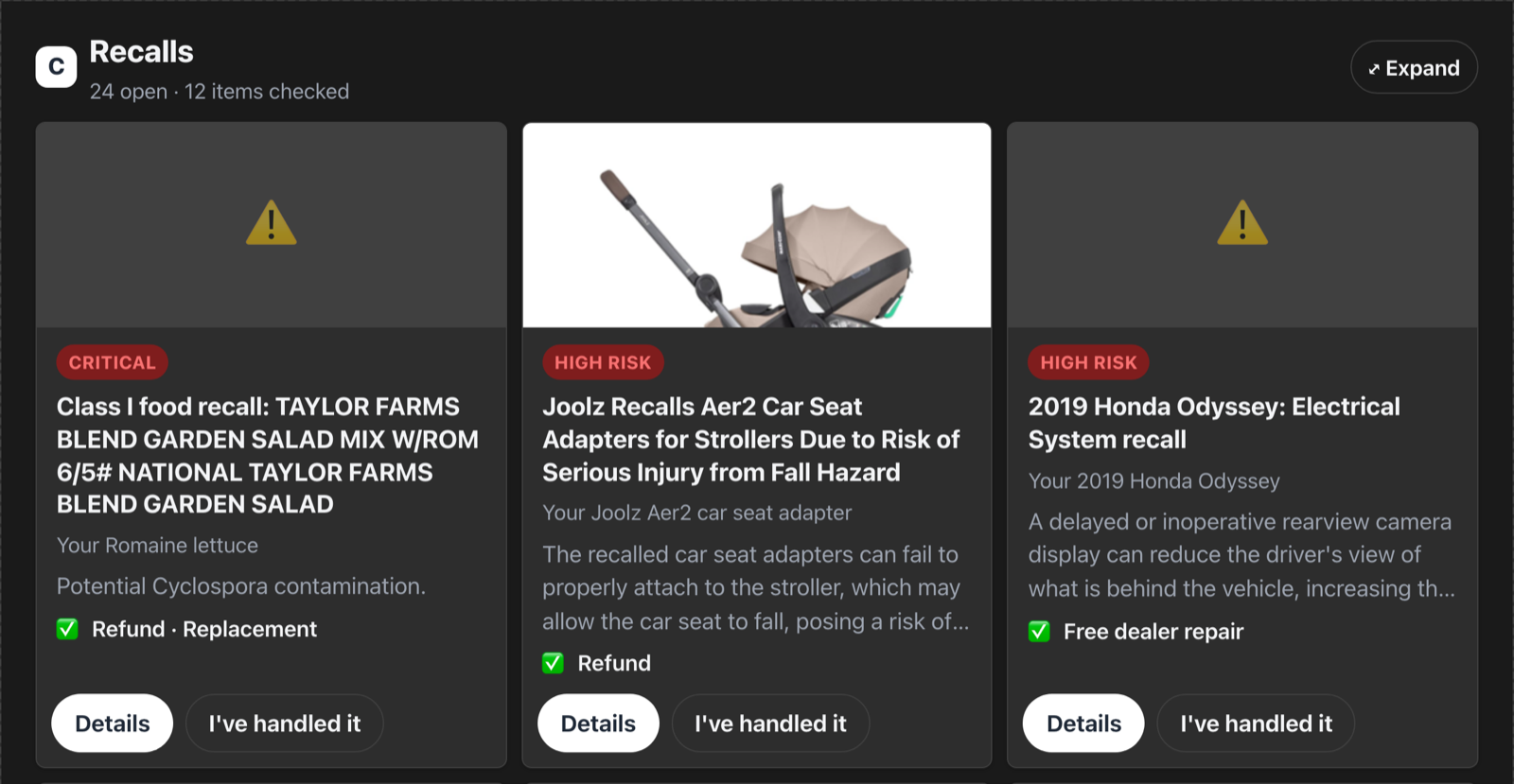
It runs as a self-hosted MCP server over Streamable HTTP, so it works from Claude, an Echo Show running Alexa+, or a script, and it ships a Preact MCP App that draws recall cards, a recall detail page, the household briefing, the maintenance timeline and the inventory when the host has a screen.
You tell it what you own, a car seat, the minivan, the smoke detectors. It keeps checking the public CPSC, NHTSA and openFDA recall feeds, tracks the small things that keep a home safe (smoke-detector batteries, filters, car-seat expiry, vehicle service, warranties), and answers in one or two spoken sentences with the remedy included. It runs as a self-hosted MCP server over Streamable HTTP, so it works from Claude, an Echo Show running Alexa+, or a script, and it ships a Preact MCP App that draws recall cards, a recall detail page, the household briefing, the maintenance timeline and the inventory when the host has a screen.
Matching is deterministic and every match carries a written reason. Candidates come from a MiniSearch index over titles, products and keywords; brand, model and distinctive-word overlap are weighted, a score of 0.5 records a match and 0.8 is spoken as definite. Keywords come from the record body rather than the title, because the CPSC feed has a record whose title belongs to a different recall, which the tests now pin with a recorded fixture. When Claude on Bedrock is enabled it adjudicates only the 0.5 to 0.8 band, and the verdict is cached on the match so it is never re-asked.
Alexa+ allows 500 ms per tool call, so no tool handler does network I/O or calls a model. All of that runs in a sweeper, hourly and right after add_item returns. The OAuth 2.1 authorization server is my own because voice assistants need a two-tier shape (client credentials for service calls, PKCE for household calls, no dynamic client registration, no WWW-Authenticate challenge) that generic MCP auth libraries do not produce.
I built it in September 2026 (the commits run from 2026-09-12 to 2026-09-23) for the Alexa+ track of Amazon Build, Ship, Shape 2026. The add-on itself was not submitted: the Alexa CLI is distributed through a private AWS CodeArtifact repository that needs an AWS account, which I do not have, so the repo stands as a portfolio piece. What I learned about the toolkit and the feeds is in docs/platform-notes.md. The screenshots were rendered with the reference MCP Apps basic-host against live recall data.