EEG dementia re-evaluation
Honest, subject-level re-evaluation of a course project that classified Alzheimer's, frontotemporal dementia and healthy controls from EEG: about 60% balanced accuracy, and no deep model beats spectral features.
Live demo
Interactive charts of saved predictions
Interactive charts of the repo's saved out-of-fold subject predictions, result tables and permutation nulls, plus a replay of the 2025 team model's training log; confusion matrices and balanced accuracies are recomputed in your browser from those saved predictions, and no model runs.
Overview
The project started in Spring 2025 in NYU's Neuroinformatics course: a graph transformer that classified Alzheimer's disease (AD), frontotemporal dementia (FTD) and cognitively normal controls from resting-state EEG on the public OpenNeuro ds004504 dataset (88 subjects, 19 channels). It reported 63.6% accuracy on one 18-subject test split, after model selection on 15-second chunks that put chunks of the same recording in both training and validation, which is why validation accuracy was 99%.
By the numbers
- 88 subjects, 10x5-fold nested CV
- 61.1% vs 33% chance
- no deep model beats features
Highlights
- 01
Re-evaluated a course project that reported 63.6% accuracy for Alzheimer's (AD), frontotemporal dementia (FTD) and controls from resting EEG after model selection leaked subjects (99% validation accuracy): every split is now over subjects, with nested model selection, 10 repeats of 5-fold CV, bootstrap CIs and permutation tests.
- 02
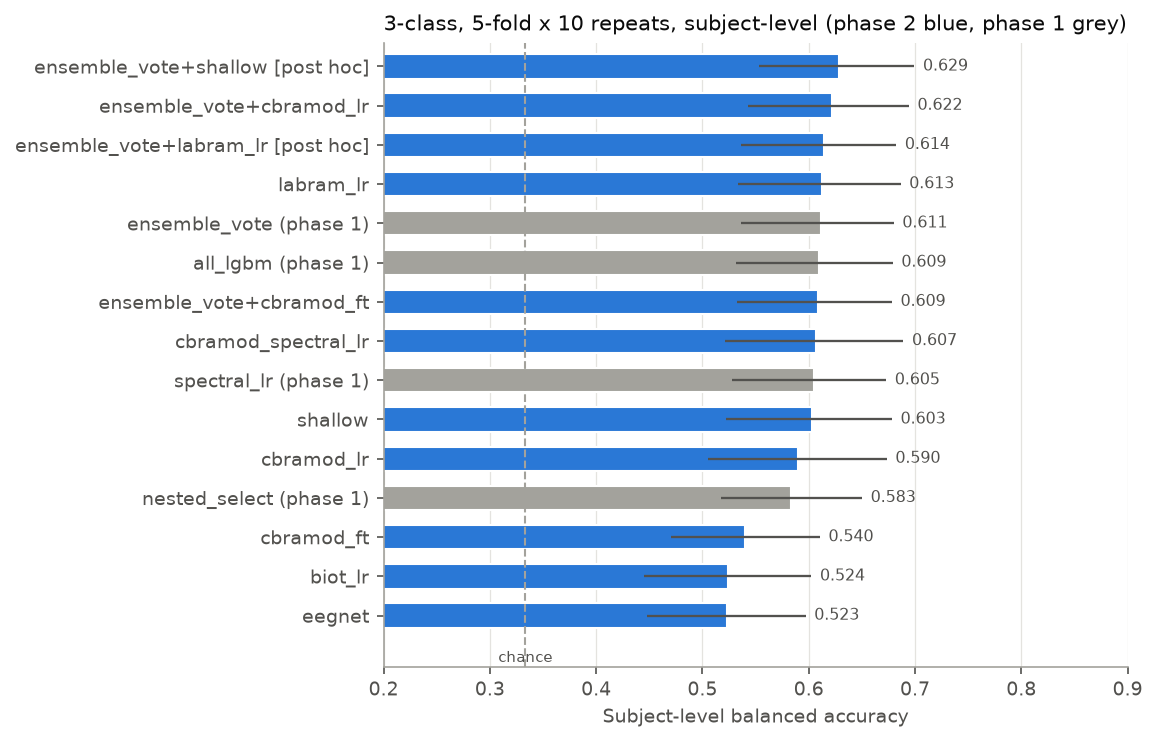
Compared 16 feature pipelines with EEG foundation models (LaBraM, CBraMod, BIOT) and CNNs under one protocol, pre-registered for the deep models: the best pre-specified model reaches 61.1 ± 3.0% subject-level balanced accuracy (chance 33%), and no deep model beats it; AD vs controls reaches 84.6%, AD vs FTD stays near 60%.
- 03
Found that 92% of every channel's variance in the distributed recordings is one common-mode artifact, which the average reference removes; leakage tests with spy estimators, and a test that fails if the README tables and the result files disagree.
The story
The project started in Spring 2025 in NYU’s Neuroinformatics course: a graph transformer that classified Alzheimer’s disease (AD), frontotemporal dementia (FTD) and cognitively normal controls from resting-state EEG on the public OpenNeuro ds004504 dataset (88 subjects, 19 channels). It reported 63.6% accuracy on one 18-subject test split, after model selection on 15-second chunks that put chunks of the same recording in both training and validation, which is why validation accuracy was 99%.
In 2026 I re-evaluated the task properly. Every split is made over subjects, hyper-parameters are chosen by an inner cross-validation on the training subjects only, and every model runs through 10 repeats of 5-fold cross-validation with subject-level metrics, class-stratified bootstrap confidence intervals and permutation tests of the whole nested pipeline. Honest three-class performance is about 60% subject-level balanced accuracy against 33% chance. The best pre-specified model, a soft vote of a spectral logistic regression, a Riemannian model and LightGBM, reaches 61.1 ± 3.0% [53.6, 68.0].
The second phase, written down before any outer-fold run, compared that with EEG foundation models (frozen and fine-tuned CBraMod, frozen LaBraM and BIOT) and CNNs trained from scratch (EEGNet, ShallowFBCSPNet). None beats the feature models: frozen LaBraM with a linear head reaches 61.3%, ShallowFBCSPNet 60.3%, and three deep models are significantly worse. With about 70 training subjects per fold the networks memorise subjects within a few epochs, and what the classifiers use is the EEG slowing of dementia that band power already captures. AD vs controls works (84.6% leave-one-subject-out, in line with rigorous studies), FTD vs controls reaches 78.8%, but AD vs FTD stays near 60% with every representation tried.
Along the way I found that about 92% of every channel’s variance in the recordings as distributed is one common-mode signal, mostly below 2 Hz and identical across groups; the original pipeline z-scored it into most of its input, and the average reference removes it. Spy estimators in the tests check that no fit call ever sees a test subject, and a test fails if any README table disagrees with the result files. The limitations are in the README: one site, 23 FTD patients, and deep models run at pre-registered defaults rather than tuned.