TideFit
Security audit, Next 14 to 16 upgrade and production launch of a roommate's Next.js trip planner.
Overview
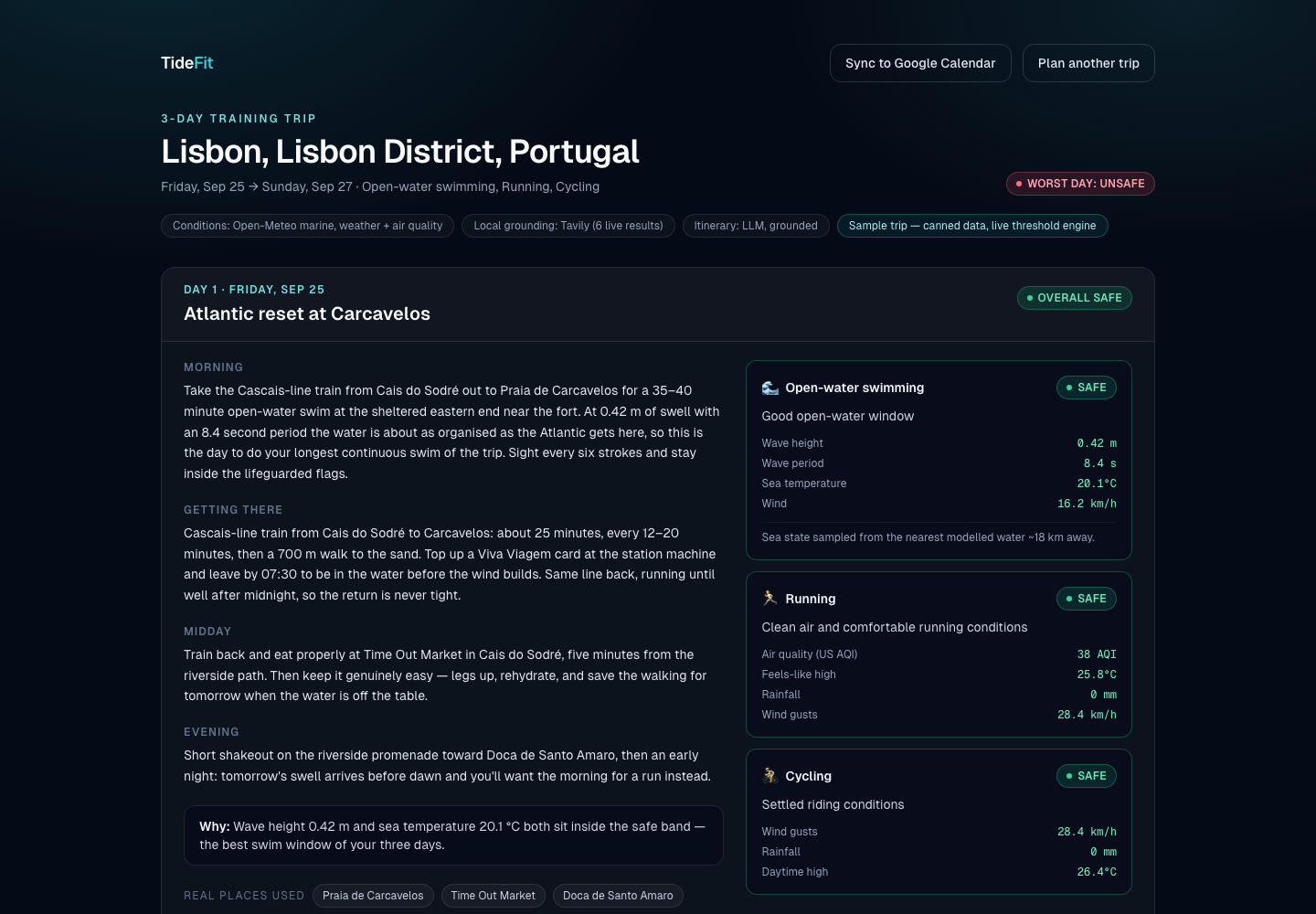
TideFit is my roommate Utkarsh Mittal's Next.js trip planner for athletes. It fetches sport-specific forecasts (sea state for swimmers, air quality for runners, wind and heat for cyclists and hikers), grades each trip day safe, caution or unsafe against tunable thresholds, and writes a day-by-day plan.
By the numbers
- 15 findings, 13 fixed
- npm audit 6 to 0
- 0 to 45 tests
Highlights
- 01
Security and correctness audit of a Next.js trip planner: 15 findings confirmed against the running app (OAuth CSRF, a Supabase policy exposing every user's trips, an app secret in a plaintext cookie, no rate limit on paid endpoints), 13 fixed and 2 documented.
- 02
Upgraded Next 14 to 16 and React 18 to 19 by hand (async cookies, middleware to proxy, ESLint 9 flat config), taking npm audit from 6 vulnerabilities to 0 and tests from 0 to 45, with CI that deploys main to Vercel once the checks pass.
- 03
Launched it at tide-fit.vercel.app with private Blob storage so shared links survive redeploys, an edge rate limit verified at 20 requests then 429, and Strava and Google Calendar sign-in verified end to end on the live site.
Try it
The story
The app is his and he gave me full permission to change it. The audit, the upgrade, the tests, the CI and the launch are mine.
TideFit is my roommate Utkarsh Mittal’s Next.js trip planner for athletes. It fetches sport-specific forecasts (sea state for swimmers, air quality for runners, wind and heat for cyclists and hikers), grades each trip day safe, caution or unsafe against tunable thresholds, and writes a day-by-day plan. The app is his and he gave me full permission to change it. The audit, the upgrade, the tests, the CI and the launch are mine.
I read all 45 source files and probed a local server that had no API keys. The high-severity findings: the Strava and Google OAuth callbacks accepted any authorization code, a Supabase policy let anyone holding the public anon key read every user’s trips, a visitor’s Strava app secret was stored in a browser cookie in plaintext, and the endpoints that spend money had no rate limit. Each of those fixes was verified: a forged callback is rejected, the anon key reads no rows, the cookie holds ciphertext, and the 11th request in a minute gets a 429 from the app’s own per-IP limiter, behind a Vercel firewall rule that allows 20 a minute. The worst bug for users turned up after the audit: the server’s UTC date survived hydration as the date input’s minimum, so the trip form would not submit every evening in the Americas.
The Next 14 to 16 upgrade was a proper migration rather than the codemod’s escape hatch: async cookies(), middleware to proxy, ESLint 9 flat config. npm audit went from 6 vulnerabilities (1 critical, 5 high) to 0 and the test suite from 0 to 45. CI runs typecheck, lint, tests and a zero-key build, then deploys main to Vercel. The work went in as 16 merged pull requests. Two low-severity findings are written up in docs/AUDIT.md rather than fixed.